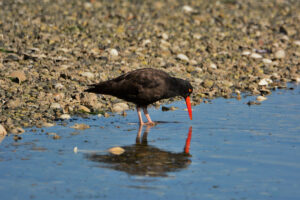
The area’s seashore, wetlands and mountains are home to a great variety of birds. You will find Black Oystercatchers on the rocks and beach of Pringle Bay, Black Eagles nesting high up Hangklip Mountain, a variety of swallows, swifts, Egyptian Geese and King Fishers near the Palmiet River by Kleinmond. The Harold Porter National Botanical Garden near Betty’s Bay is home to a variety of birds including the famous Cape Sugarbird.
The African Black Oystercatcher is southern Africa’s second rarest coastal breeding bird. The total population is less than 5 000 birds. The Oystercatcher’s glossy black plumage, bright red eyes, beak and legs, and plaintive piping call make them a distinctive and very appealing species. These birds occur along the coast and off-shore islands from Namibia to the Easter Cape. They are usually found on sandy or rocky shores and are often seen on the rocky shores of Rooi Els and the sandy beach of Pringle Bay. They almost always occur in pairs or small groups. The breeding season is from September to March. Usually, two eggs are laid, of a greenish or buff stony colour with dark brown spots, which provides an effective camouflage against predators. The name Oystercatcher is misleading as they feed mainly on mussels, limpets, whelks, crustaceans and various worms, rarely if ever taking oysters!
Oystercatchers are very sensitive to disturbance by beachgoers, fishermen, dogs and vehicles. They are also threatened by coastal developments with destroying their habitat. Breeding adults are easily stressed and they may even desert their nests if they are disturbed too often. The disturbance may create an opportunity for kelp gulls to pray on eggs or chicks. Try not to step on the well-camouflaged nests, eggs and chicks.